

The Texas 7-Year Background Lookback Explained
What the Texas 7-year lookback covers, how older vs newer offenses are treated, where HUD guidance stands after the September 2025 rescission, and how property policies vary.
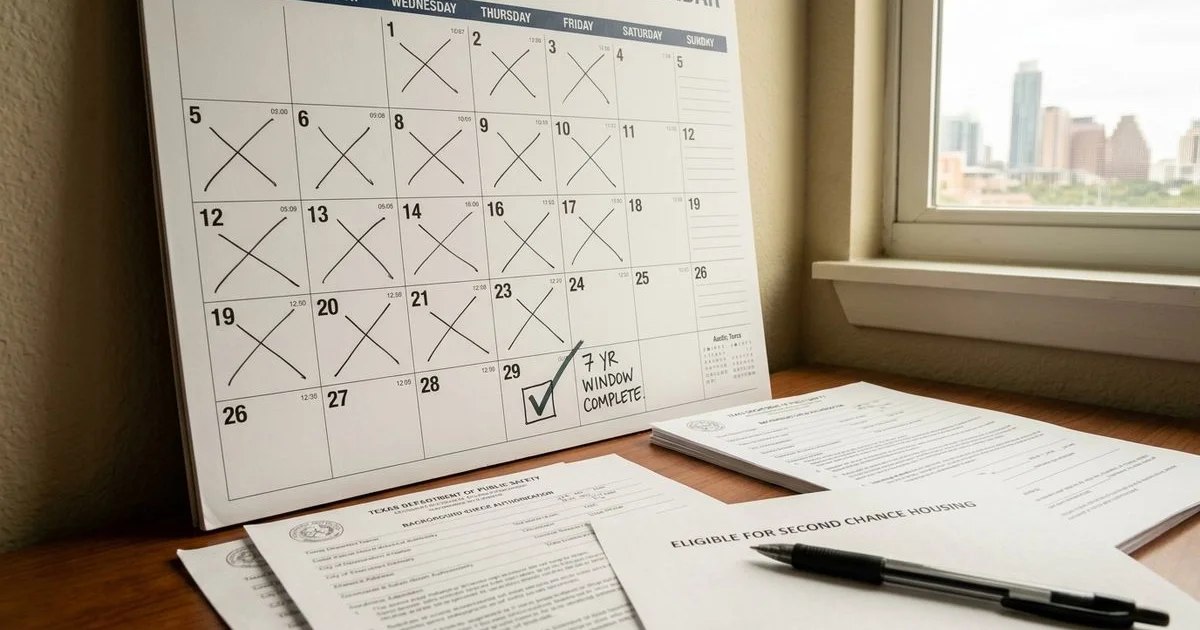
If you have a criminal record and you’re looking at apartments in Austin, the 7-year lookback is the single most important rule to understand. It’s the difference between a record that surfaces in your screening and one that effectively doesn’t. Here’s exactly what it is, how it’s applied, and how to use it.
What the lookback is
The “Texas 7-year lookback” refers to the standard time period that most consumer reporting agencies use to report adverse criminal information for non-conviction events or records older than 7 years. It comes from federal law (the Fair Credit Reporting Act, or FCRA), which limits reporting on non-convictions and certain other records to 7 years from the date of the event.
In practice, most apartment screening services configure their background checks to look back 7 years. Records from before that window often:
- Don’t appear at all in the screening output
- Or appear but are weighted very leniently
- Or appear with explicit “outside lookback” notation
The result: an offense from 8+ years ago often doesn’t even register at standard-configured screening, even when it’s still technically a public record.
What’s covered (and what’s not)
The 7-year lookback typically applies to:
- Non-conviction records (arrests without conviction, dismissals, deferred adjudication outcomes)
- Civil judgments
- Paid tax liens
- Most misdemeanors after the look-back period
It often does not apply to:
- Felony convictions: these may surface beyond 7 years at strict properties
- Sex offense registry data: handled separately, longer lookback
- Pending cases: currently in process, not subject to lookback
- Federal certain serious offenses: handled property by property
So “outside the 7-year window” is a strong tailwind for non-violent offenses, especially misdemeanors and certain felonies. For more recent felonies (especially violent), the lookback isn’t a free pass.
How property policies stack on top
The 7-year FCRA lookback is the federal floor. Individual properties configure their screening on top of it:
- Most properties: 7-year lookback (standard)
- Some flexible properties: shorter lookback (3-5 years), which is more lenient
- Strict properties: longer lookback (10+ years) for felony convictions; rare but exists at upper-tier properties
So your specific offense may be inside one property’s lookback and outside another’s. That’s why pre-screening matters: knowing each property’s actual policy is the difference between an approval and a wasted application.
Where HUD guidance stands now
HUD rescinded its criminal history guidance on November 25, 2025, so no federal guidance now discourages blanket bans. The Fair Housing Act didn't change, and blanket bans can still disproportionately affect protected groups under the Fair Housing Act, so they can constitute discrimination.
Practical effect for renters with records:
- Many properties, especially those receiving federal funding (voucher accepted, HUD-funded), have moved to individual review rather than blanket bans
- Properties doing individual review consider offense type, age, time elapsed, and evidence of rehabilitation rather than just the existence of a record
- Where the review still runs, it applies most readily to non-violent offenses
This is why HUD-aware properties tend to be more flexible than strictly private market properties: individual review is the more permissive screening model for renters with records.
Strategy by offense age
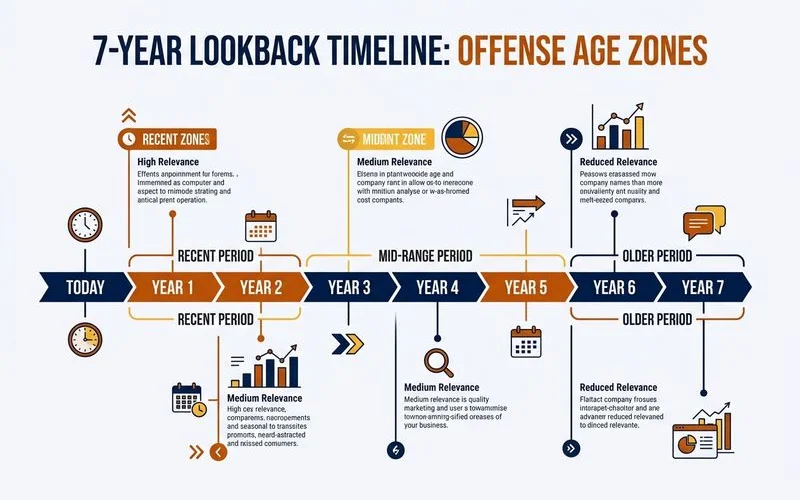
The 7-year lookback gives you a clear strategy variable:
- Older than 7 years (non-violent): most properties don’t see it. Apply broadly across the flexible on credit mid tier and you’ll have wide options.
- 5-7 years (nonviolent): pool narrows. Target properties with explicit shorter lookbacks (3-5 years) plus individual review.
- 3-5 years (nonviolent): individual becomes key. Pre-screening prevents wasted fees on properties with strict lookbacks.
- Under 3 years: hardest stretch. Documentation and a guarantor matter most. Pre-screening is important.
For the practical application of these ranges to specific offense types, see renting with a nonviolent felony over (and under) 7 years.
What about expungement and non-disclosure?
In Texas, certain records can be expunged (fully removed from the public record) or sealed via an order of non-disclosure (hidden from most background checks but still accessible to law enforcement and certain entities). Both are possible for some offense types after specific waiting periods.
If you’re eligible for either, pursuing it can dramatically widen your apartment options. Texas RioGrande Legal Aid and the Texas Fair Defense Project offer help understanding eligibility. The waiting periods vary: usually 2-5 years post-disposition for most eligible offenses.
Practical takeaways
- Know your offense date. The year matters more than most renters realize.
- Calculate your time from disposition. Not the offense date. The disposition (conviction, deferral completion, dismissal).
- If you’re 1-2 years from the 7-year mark, sometimes waiting before applying to strict properties makes sense.
- Don’t assume strict properties everywhere. The 7-year lookback is the floor; many properties don’t go further.
- Use individual communities for offenses inside the window. That’s the lever.
Ready to find Austin apartments whose lookback policies work for your specific offense age? Request your free list →
Frequently asked questions
How far back do Texas apartment background checks go?
Most apartment screening uses a 7-year lookback, though some review further for certain offense types or for properties with stricter policies.
Do offenses older than 7 years still show up?
Some can, depending on the screening service and offense type, but they're typically weighted far more leniently or filtered out entirely.
Does HUD guidance still affect criminal screening?
Not any more. HUD rescinded that guidance on November 25, 2025. Many communities kept individual review anyway, because the Fair Housing Act didn't change and a blanket ban still carries disparate-impact exposure.
Ready for a custom background list?
Tell us your situation. We'll send a list of Austin apartments that will approve you, usually same or next day, free, no upfront fees.
Get Your Free List